
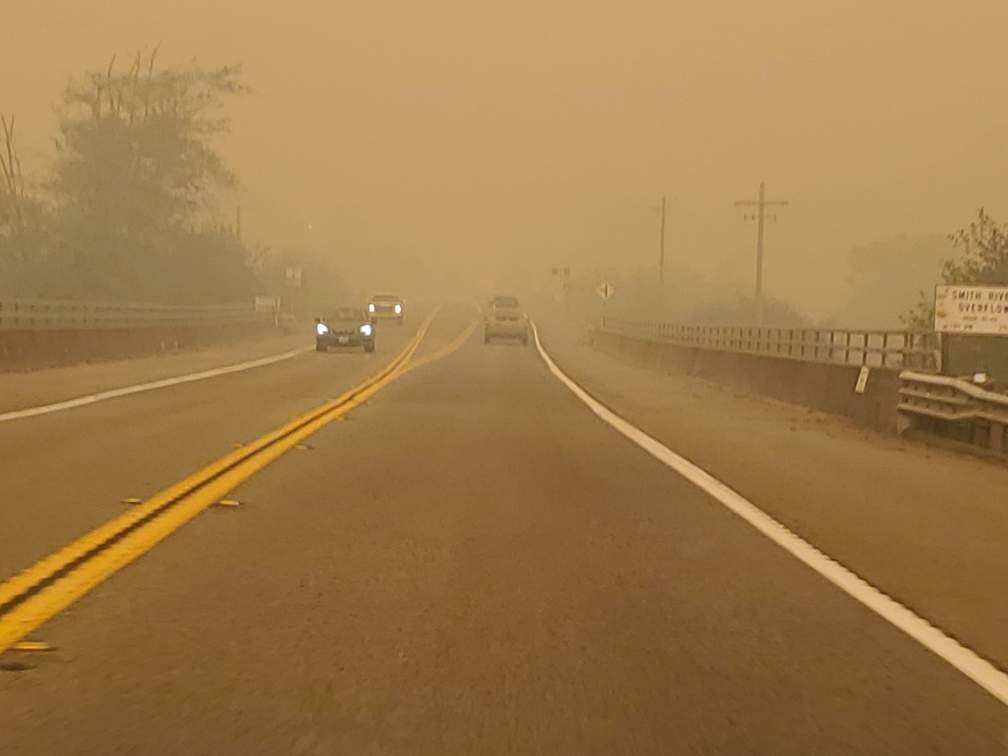
Daily smoke production from the Six Rivers Lightning Complex has decreased significantly, however the Mountain Fire in Siskiyou County became more active and has been creating smoke in that region.
Cooler temperatures are expected today through the remainder of this coming week which will moderate fire behavior and smoke production. The upper level ridging is forecast to break down due to a passing Trough, and provide W-SW-S transport winds away from the Coastal influence. Smoke conditions should continue to improve today and through the beginning of the week.
Air quality monitors and the current Air Quality Index (AQI) for communities should be viewed at https://fire.airnow.gov. USFS Air Resource Advisors (ARAs) may be assigned to certain fires impacting our area and may be providing daily Smoke Outlook Forecasts on one or more of these fires. (https://outlooks.wildlandfiresmoke.net/outlook).
ALERT – Hazardous (AQI 301 and higher, 24 hr. avg): None
ADVISORY – Unhealthy to Very Unhealthy (AQI 151-300 range, 24 hr. avg): None
Regional Smoke Outlooks – Good , Moderate , to Unhealthy for Sensitive Groups (AQI 0-150 range):
Del Norte County:
- Crescent City – Good
- Gasquet – Good
- Klamath – Good
Humboldt County:
- Eureka (including Trinidad to Scotia, Blue Lake) – Good
- Kneeland – Good
- Weitchpec, Orleans – Good
- Hoopa – Good to Moderate
- Willow Creek – Good to Moderate; haze
- Bridgeville – Good
- Garberville/Redway – Good
Trinity County:
- Burnt Ranch, Salyer, Hawkins Bar – Good to Moderate; some haze
- Weaverville – Good to Moderate
- Hayfork – Good to Moderate
- Hyampom – Good
- Junction City – Good to Moderate
- Trinity Center – Moderate; possible haze
Particulate Matter (PM2.5) monitors are located in Eureka, Crescent City, Orleans, Weitchpec, Hoopa, Willow Creek, and Weaverville. Air quality monitors and the current Air Quality Index (AQI) for communities should be viewed at https://fire.airnow.gov.
USFS Air Resource Advisors (ARAs) are assigned to certain fires impacting our area and are providing daily Smoke Outlook Forecasts on one or more of these fires (https://outlooks.wildlandfiresmoke.net/outlook).
Fire information can be found at http://inciweb.nwcg.gov/ or https://fire.airnow.gov/. Current weather information can be found at www.wrh.noaa.gov. As with all wildfires, ash fallout is possible depending on fire activity and proximity to the fires. Ash fallout information can be found in the Wildfire Smoke Resources section of our webpage at www.ncuaqmd.org.
Health Information & Actions to Protect Yourself from Smoke Impacts
Concentrations of smoke may vary depending upon location, weather, and distance from the fire. Smoke from wildfires and structure fires contain harmful chemicals that can affect your health. Smoke can cause eye and throat irritation, coughing, and difficulty breathing. People who are at greatest risk of experiencing symptoms due to smoke include: those with respiratory disease (such as asthma), those with heart disease, young children, and older adults.
These sensitive populations should stay indoors and avoid prolonged activity. All others should limit prolonged or heavy activity and time spent outdoors. Even healthy adults can be affected by smoke. Seek medical help if you have symptoms that worsen or become severe.
Follow these general precautions to protect your health during a smoke event:
- Minimize or stop outdoor activities, especially exercise.
- Stay indoors with windows and doors closed as much as possible.
- Do not run fans that bring smoky outdoor air inside – examples include swamp coolers, whole-house fans, and fresh air ventilation systems.
- Run your air-conditioner only if it does not bring smoke in from the outdoors. Change the standard air conditioner filter to a medium or high efficiency filter. If available, use the “re-circulate” or “recycle” setting on the unit.
- Do not smoke, fry food, or do other things that will create indoor air pollution.
Consider leaving the area until smoke conditions improve if you have repeated coughing, shortness of breath, difficulty breathing, wheezing, chest tightness or pain, palpitations, nausea, unusual fatigue, lightheadedness.
For further information, visit the District’s website at www.ncuaqmd.org or call the District’s Wildfire Response Coordinator at (707) 443-3093 x122.