
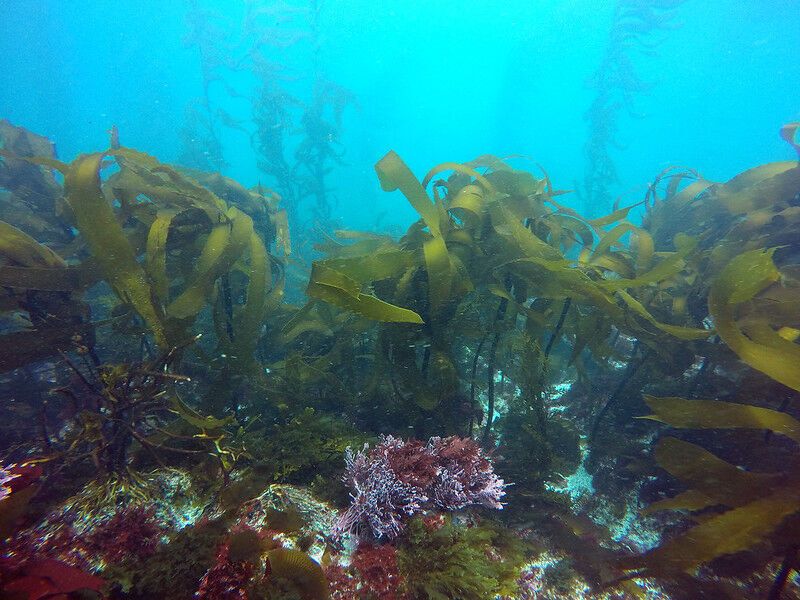
The kelp forests off the Mendocino coast are starting to recover with improved environmental conditions, thanks to a conservation program which sent divers to remove 45,000 pounds of purple sea urchins.
The urchins have devastated the once massive bull kelp forests, leaving a lifeless barren behind.
Dan Abbott, kelp forest program director for the Reef Check Foundation, said it is the first large-scale kelp-restoration project of its kind in northern California.
"It's not back to where it was, say pre-2015," Abbott acknowledged. "It's still only about 20% of the historical average. But again, it's only like a year and a half in. And it's a very encouraging result."
The purple sea-urchin population has exploded in the last eight years or so, partially because a wasting disease has decimated their chief predator, the sea star. In addition, the area has no sea otters to keep the urchins in check, because the otters were hunted to extinction in the early 1900s.
Sheila Semans, director of the Noyo Center for Marine Science in Fort Bragg, said the kelp forests are crucial habitat for hundreds of species.
"The sea lions hunt in it, the abalone eat it, the rockfish hide in it," Semans outlined. "There's just so many ecosystem services that it provides. On top of that, it sequesters carbon, and it buffers wave action along the coast."
The Noyo Center also is working to create a new fishery for purple urchins, which can be fattened up in an aquaculture facility and sold. The California Department of Fish and Wildlife said it plans to develop a comprehensive statewide Kelp Recovery and Management Plan over the next five to 10 years.